Post Vault

Showing posts with label Op Ed. Show all posts

8.31.2021

Foundation Leveling


Spoiler Free, btw. 

 Over the last few years I’ve been digging into the works of many classic sci fi authors. It started when I found an old Isaac Asimov short story collection that belonged to my father-in-law. I’ve always enjoyed science fiction in other media but I feel that was my first real experience reading full on sci-fi literature. I was intrigued by the notions of far off planets, space stations, all-knowing supercomputers, and of course, robots. After that I dug into a few of the classics of Arthur C. Clark, Robert Heinlein, and Phillip K. Dick, and lesser known but also important authors like Andre Norton. When looking through bibliographies and figuring out what to read next I always came across Asimov’s Foundation. But looking at the expanse of volumes it covers I found it a bit too intimidating to just jump in. I looked elsewhere and read other books. 

And then I found out Apple TV is making a Foundation TV series. I was coming up on the end of my latest read and I decided it’s time to dig in, so I hopped on ebay and ordered book 1. I picked it up and I found it pretty engaging enough. I never read too much about the book series beforehand. I just knew it was about a man by the name of Hari Seldon who comes up with a plan to save the galactic empire, which is falling to ruin. Asimov’s keen writing kept me glued to the book, and because I had the small, pocket paperback editions it was easy enough to pick up and read when I had even just a few minutes to spare. 


Trilogy cover art by Michael Whelan

One of the first things I noticed (especially in the first trilogy of books) is that you’re not weighed down with overly descriptive paragraphs of vague future technology or the way things work in the distant future. As these first 3 were written early in his career, Asimov kept the depictions of technology to a minimum. Instead, the early stories focused more on the character’s motives and missions, showing how they maneuvered politically to get things done and move the plot (and The Seldon Plan) forward. That first trilogy is very political, indeed. 


The biggest thing that stuck with me, though, is the scope of the entire series. The plot of the story moves along the course of 1000 years. In the beginning a desolate planet called Terminus is settled by a cluster of scientists and historians, and through the course of the entire story that planet and its population are somewhat a focal point. Reading about that got me thinking about the unspoken microcosms within the world of Foundation. While the main characters are out and about making their moves, sealing their deals, I imagine worlds on these planets are being built and torn down. A lot can happen in 1000 years. Just look at America and all the bullshit we’ve been going through. All these (still ongoing) fights for rights and equality, the old ways versus the new ideas, and we’re just 245 years old. 

The idea of social revolutions taking place on Terminus as the story moved along bubbled in the back of mind. The universe is not a utopian one, in fact, that’s why the Foundation was created, to save humanity from an extended period of chaos, so of course the people on any planet would be going through stuff. With communities growing and being built you have to imagine that there are city planners working out the detailed layout of these futuristic, far-off cities. In fact, it makes you wonder that in 20,000 years if mankind has civilized the galaxy, maybe they’ve learned a thing or two about infrastructure planning, so settling new cities doesn’t lead to all the problems we deal with here and now. 

Thinking about the wide scope of the story also got me thinking about how technological advancement happens within a civilization and how it affects people and cultures. For example, humans have had this invention of the automobile now for over 120 years. That’s it, just 120 or so years, and in that time it’s amazing how much this invention has shaped the landscape of how we built our society, and how it’s shaped the subcultures within. Not only is the actual industry of the automobile an economic force to be reckoned with, but it is also cemented within smaller communities such as hot rod and lowrider enthusiasts, among others. The term ‘Car Culture’ exists for a reason. Our society wouldn’t look the same today without this colossal invention. And so, what sort of inventions are shaping culture in the universe of the Foundation series? 

While it’s somewhat a given that humankind is, technologically, always moving forward, Asimov doesn’t really mention it until book 4. In the original trilogy, instead, he presents civilization as having achieved a certain level of advancement, however some of that advanced technology is only available on certain planets. High technology exists, it’s just not at everyone’s disposal. And what this technology is, other than described as nuclear-powered, is all up to your imagination. Within the editions of the books I read contained a four page blurb detailing the scenario of how the Foundation series came to be. Among the many insights discussed in that blurb was the fact that the original trilogy came out in the 1950s, and by the time Asimov returned to writing the remaining books in the 1980s science had made so many more discoveries and advancements. He mentions an example such as the discovery of black holes within that time. Indeed, I’m glad he left out any overly detailed technological descriptions of the future in the original trilogy, it would have made the series far less timeless than it is now. 

However, when he returns to form in Foundation’s Edge, book 4, descriptions of new technology are perfectly apt and fit right in with the story. His idea for a computer interface within the protagonist’s ship, the Far Star, is fresh and even by today’s standards pretty impressive. In fact, the whole of this ship is fascinating. He imagined an interstellar spaceship that was so advanced, even for this society, that it is propelled by gravitic forces instead of rocket propulsion. And considering a few short years ago we just discovered gravity waves, that’s a mighty impressive speculation. 


The last two books are rife with all kinds of astronomical terminology and ruminations. You can tell Asimov followed all these discoveries closely and was excited to use these ideas. The last two books are very thick when compared to the original trilogy, and that’s because he explores these ideas fully and descriptively. 

Of course there were other elements at play within the whole of the story, a big one is the notion of mentalics; humans with the ability to read and/or manipulate the minds and emotions of others. It sounded kind of campy at first, but as this dynamic got woven into the story it leveled the playing field between the humans with political power and technology and those without. It’s an interesting idea, albeit a more fantastical one, but who knows where human biology will be in 20,000 years. In books 4 and 5 we’re introduced to a few variations of the human species, one of which is a planet with the entirety of its inhabitants and objects sharing a single consciousness, and the other is an intersex (the term hermaphrodite is used in the novel) society that has biologically-developed cranial lobes behind their ears capable of transducing energy. Some interesting concepts, indeed. 

The big difference in the last two books as compared to the original trilogy, is that the politicking and the passage of time through the ages has become non-existent in favor of a few central characters and their quest through space. Well, our main character does a few political maneuvers from time to time, but gone are the tales of noble citizens ascending the ranks to make moves to insure Hari Seldon’s plan. I would have liked to hear about Seldon’s hologram appearing one more time, it would have tied the series together a bit more. But I think by this time Asimov was more interested in a singular adventure narrative as opposed to the descriptions of space fleets and conquests of planets. While the original trilogy covered all sorts of characters and politicians through the span of 400 or so years, the last two books followed the same handful of characters through nearly 1000 additional pages. It’s quite telling of the author’s headspace then and now. 

Another thing the scenario blurb mentioned was how when he started the series Asimov was really into the fall of the Roman empire, and was fresh off the heels of reading up on it’s play by play history. I find it extremely fascinating how he could be so moved by something very real and very grand historically speaking, and he took that inspiration and crafted something amazing from it. The original trilogy presents something that mirrors that history, deconstructs it even, and uses it as a way to imagine an illustrious yet troubled future for humankind. It goes to show that even as humankind advances we are never far off from a slip up, and that that advancement can come tumbling down. Plus, I know the feeling of drawing inspiration from something that’s right under your nose and it’s exhilarating.

 Overall, I enjoyed the series very much. However, while I was digesting what I had read I couldn't help but feel sad and disappointed. And it’s not from the book themselves but going back to the scope, the perspective that came with imagining humankind in 300, 1000, and 20,000 years from now. With everything going on today, especially this looming kaiju we call climate change, I've been hit with a reality check that we still have a very long way to go as a civilization. I used to think, I think we all did (or still do), that we would see some futuristic-type things in our lifetime, the classic go-to being flying cars. Peace in the middle east, the end of starvation, virtual reality with a practical use, any one of these also fell into that category. And perhaps that’s just the positive framework that my generation was raised with, that we, us, would go forth and change the world for the better. Naive sure, but at the time when we were finishing high school and stepping out into the world everything seemed to be on the up and up (Pre 9/11). 

"You son of a bitch, you did it..."

Thinking about the scope of human civilization from reading these books has smacked me back to reality that we are indeed, as individuals, not all that special. Sure, we’re special in the sense that what we do here on earth has an immediate effect on those who are involved in our lives, but most of us will never be famous or renowned for anything we do in our lifetimes. We like to think we’re so important now and what we do has to have some kind of deep meaning, and then we die and civilization keeps moving on. I even realized that those people we do hold in high regard; famous artists, researchers that have contributed scientific breakthroughs, leaders of countries, etc, aren’t necessarily special or different from us common folk, and they too will eventually be brushed aside by the passage of time. Essentially we are just another generation raising up another generation, who’ll ideally grow up and raise another generation. So on and so forth. Except now we’re facing something that has the potential to end the continued proliferation of the human race. 


My sadness and disappointment stem from the notion that while we have a civilization full of famous people, philanthropists, charismatic leaders, and generally everybody wants to do and be good, nobody really wants to be great. Being great meaning somebody willing to lay down their power and wealth and use it to fundamentally change the world for the better. Not just donating to charities or food banks (which we do need, don't get me wrong), but people with the power to halt the current zeitgeist in its tracks and help mankind get on the right course to build a future that will eventually allow humans to take to the stars and civilize galaxies. And you know who I’m talking about; billionaires with so much money they couldn’t possibly spend it all in 1000 lifetimes; religious leaders who can mutter a sentence and have their followers bend the knee the world over, and so on. These people could use their power, wealth and influence to change the world today if they wanted. It’s the type of power that can tear down economies and break down borders, because that’s the kind of power we will need if we’re going to get past this hump, this supposed Great Filter we may be facing. 

Needless to say this book series got me feeling a certain way. And like great sci-fi, great literature at that, it has stretched my mind with new ideas and a fresh new perspective. So, how will the new TV show fare with bringing these old ideas to a fresh audience? The narratives in the book can be followed easily, it’s just fleshing out the actions and motions that are carried out in between the paragraphs. Basically it’s gonna take some decent writing to punch up the political drama to keep the viewers interested. With so much covered within the books I read (and including the 2 prequels I didn’t) there’s plenty of source material, backstory, and call-back surprises to make up an epic series. We’ll get to see battling star fleets, grand palaces and far off worlds of a future civilization, and I can’t wait. 

Honestly, though, the series has it’s fans who can’t wait to see how this will come to life, and, even if the adaptation isn’t keen, will probably still tune in. I’m just not sure how the general public will receive a story like this. Potentially, this show has the backing (story and production) to become a great one, but if the audience at large finds the story too grand or the scope too big they might just drop off or not pick it up to begin with, which means it’s a wrap for an expensive series like this one. But I’ll be rooting for it when I tune in this late September. See you on Trantor! 


6.23.2021

Commissioning Commissions

As a designer and illustrator I’ve worked with all kinds of clients and requesters of high quality fine art, and there are a few things you should know to get the best out of the artist for that commission you’ve requested. Not sure how many other guides are out there but I think it’s fair to say many artists and designers will agree with this list. Follow these guidelines to make it easy on your artist and in turn they will churn out amazing work which will feel more than worth it. When it comes to commissioning art work or design work here’s a quick rundown of things you should do and not do:


DO: Pay attention and see if your artist is accepting commissions or not. A lot of times artists put it in their bios or websites Accepting Commissions or Commissions Open. If it’s not explicitly stated anywhere on their profile or website (seriously take a minute and try and locate this info, if it exists it’s meant for you to find) politely shoot them an email asking if they’re accepting commissions (once again they do have their email posted somewhere, find it, do a little bit of work, it won’t kill ya). If no email is found politely shoot them a DM and ask if they’re accepting commissions and that’s it. This brings us to-


DON’T: Blow up their DMs outlining and detailing the full idea of the project without them asking for it. Do not send them the concept video, do not send them links to past works or projects, do not send them links to whatever this art will be tied to unless they ask for it. This has happened a few times to me. And you know what I tell them? Two words: cool story. And that’s it. Or I’ll direct somebody to email me the details, story, ideas, links etc. and drop my email address to send it to so we can talk about how we can go about doing this commission. And what do they do? Proceed to send me everything in my DMs completely ignoring my request to email it to me. If you can’t follow my directions are you even serious about this project? I’ll just leave you on read.


DO: Have a budget. Figure out what you’re willing to pay for what you are requesting and communicate it. If you feel your funds are a bit tight but this request is very important let the artist know. Seriously, just talk and don’t be afraid to ask. We’ve been broke before and know how it feels. Be upfront so we know what to expect as far as payment and we can deliver a product that is fair to both of us. This brings us to-


DON’T: Be surprised when asked to pay at least half up front. It’s standard practice to ask for half down so we know you’re serious. And don’t be surprised if we don’t take your job/request seriously if there’s no money to back it up. So have half ready to go. Some artists may only take the whole fee up front so be ready for that as well. Tip: If you volunteer the whole fee up front with no delay you just may get special priority.


DO: Have a deadline. Okay, so you’re pretty chill and don’t have an exact deadline for what you want. You tell the artist “It’s no rush, just whenever you get a chance.” Unless your artist is extremely regimented (and you paid in full up front) don’t expect anything to be done anytime soon. You’ve just given your artist an imaginary chore and it’s down at the bottom of the list, because when will they have a chance? They have deadlines to meet! Even if there is no rush pick a date out of the air; two weeks, one month, a day before the day it’s needed. Anything. Have a due date and we’ll take it seriously. Need something rather hasty? Be ready to pay a rush fee.


DO: Know what you need. This one is a bit tricky depending on the situation. Many a client have stressed me out/pissed me off because they give me instructions for their request, I bust my ass and finish it, and they turn around with a list of changes because they weren’t specific enough or they decided they don’t like how this looks after all. This wishy-washiness makes more work for the artist and begins to supersede the initial agreed upon price. This makes for a disgruntled artist who may or may not rush the job just to get you out the door and out of their life. Know what you want. Be very specific if specifics are important. Pay attention to the details and requests you are giving your artist. Do not provide certain examples and then not like the work because the artist stuck close to the examples. If you’re not sure how the request may turn out, do communicate that you would like a concept open to changes because you may or may not be sure of the final product, that way we can work it into the pay system. See number three. Also this one goes hand in hand with the last one.


DO: Know who you’re talking to. The adverse of this sometimes makes for the wishy-washiness of the above step. This one is pretty straight forward; understand what the artist you’re contacting does and does not do. A comic artist will churn out some fantastic full figured black and white ink illustrations. A vector artist will turn out your new logo design sized and ready to go. An animal painter will excel at that dog portrait you’d like to get your cousin. Do not ask a landscape painter to design your business card. Do not ask the erotic illustrator to draw your next children’s book. Do not ask a comic artist to build your next website. And while those artists may dabble with those requests (indeed they may accept them cuz they need the money), the results may not turn out as top notch as you expect them to.


DO: Trust the Artist. You’re dealing with a professional, and the pros just don’t dole out crap to their audiences (at least intentionally). So please relax, sit back and let us do our job. You paid up front and gave us a deadline, prepare to see the work on that deadline. If any issue should arise you will hear from us. We wouldn’t hand it back to you if we didn’t feel it was worthy of you and your fee. 


I think that does it for me. Fellow artists, if you have any other tips I forgot to mention let me know in the comments!


6.21.2020

Big Floyd & Beyond

Posted to my Instagram June 1st, 2020: 
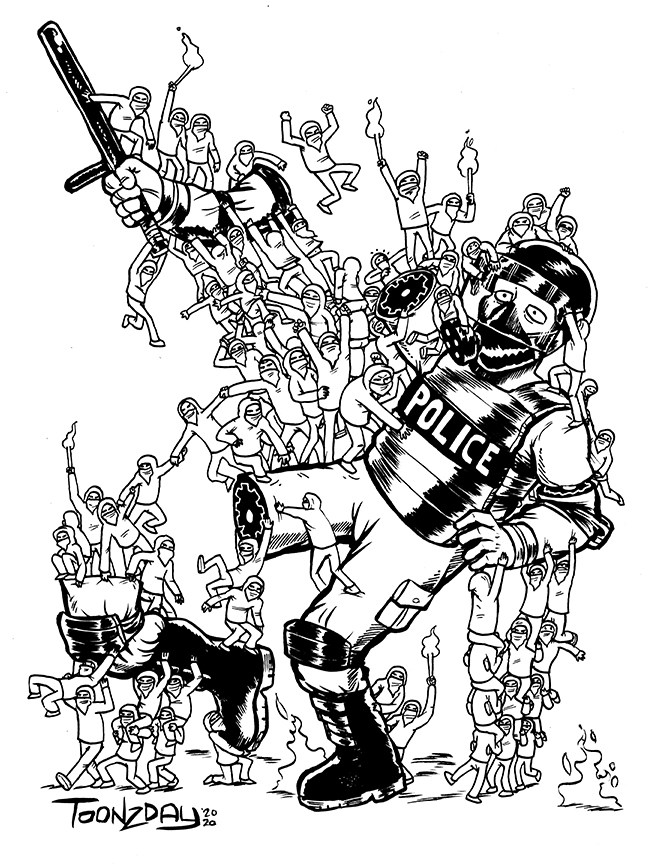
I drew this yesterday as I ruminated over the unfolding events this past week, this past month really. Every time something like this happens I become livid, infuriated. All this senseless death, whether in the street or busting down the wrong door, it has to stop! I'm sick of it, and the people are sick of it too. I don't think it's enough to just implement a few changes, we have to dismantle the system itself. We tried marches, kneeling, voting, policing our own communities, incorporating new technology, but the violence against people hasn't ceased in the least. The whole system is rotten and does not serve who we're told it is meant to serve. We must think of a new way to peacefully and compassionately maintain the rule of law among citizens, but before we can begin we ALL must acknowledge that this doesn't work. It's ridiculous! There's no excuse, none. I stand for justice for George Floyd, Breonna Taylor and the countless others who have lost their lives senselessly to law enforcement officers and their vigilante counterparts. Black Lives Matter! Fight the Power! Dismantle the System! Rebuild for the Future!

And now, as I type this post, the first officer charged in the death of George Floyd has had his charge up'd to a more serious one, and the other 3 officers at that scene are being charged as accessories. All the protesting across this country (and others) is finally working in getting these officers charged for their crimes. But the work is not finished yet. Oh no. Far from it! Now it's time seek justice for all the others. And that justice lies not only with charging the guilty officers with their crimes, no. It will come once we bring down the racist system that has allowed all of these heinous crimes against American citizens to persist through the decades. The fight to dismantle the system has begun.

Never before has our society been inundated with so much evidence of police brutality, both before these protests with new stories coming to light, as well as during these protests as we all watch armor-clad, helmeted soldiers of the empire march onto the people "they're sworn to protect", cracking heads, macing faces, and popping off tear gas canisters. We're all watching in abject horror as our feeds get fed with video after video of such atrocities as a defenseless homeless person getting shot in the face, as a 75 year old man posing no real threat gets forced to the ground hitting his head, as an off duty cop rages at a little white girl showing her support for BLM with her homemade posters. It's becoming increasing clear that those charged to protect and serve our society have a predilection of antagonizing minorities while unquestionably protecting the rich and the property they hold. And this new widespread awakening of the American public makes me very hopeful for the future.

This type of thing has always been known by me and my peers, by my community and other adjacent communities. We've all known police are bastards and you just want to avoid them at all costs. We've all understood they are never really here to help you, and if given the opportunity just might hurt you, either physically or legally or both. 

That's right. My peers have all realized that the police can legally fuck up your life. Whether it's through a trumped up marijuana charge that ends up costing you months of your life and thousands of dollars, or if they roll up on you and think you're pulling out a gun with you paying the ultimate cost. It's real. It's been a reality for decades. And for all those decades we've been trying to tell our white peers that this is real but we kept getting met with groans and eye rolls, suggestions to not resist arrest, or you shouldn't do the crime or it's few bad apples etc. (although our poor white friends did understand being financially raped by the system).

Now the year is 2020, and with camera phones as ubiquitous as they are it is becoming abundantly clear to our white peers and others around the world that the U.S. has a serious systemic problem with the police. And as our feed gets fed with protest videos and images of protest signs the overall message of FUCK THE POLICE is coming out strong. 

As this thing has been unfolding, I've been reluctant to blatantly state FUCK THE POLICE, in this and other wording, in my feed because I have a friends and family that are police and I didn't want to alienate them. I did not want to come off as unsupportive of them specifically, even though I DO NOT LIKE POLICE. Well, I'm tired of pussyfooting around about posting the memes and mincing words. FUCK THE POLICE. DEFUND THEM. DISMANTLE THEM.

And to those police friends and family members who may be quick to tell me what a dangerous job they have or how they are one of the good ones and are fighting the good fight blah blah, just keep telling yourself what you need to believe to justify your career. In the end though, that's all it is, a career. I know you've worked tirelessly to get where you are, to earn your rank or whatever but it's just a job. 

Maybe you should quit. Stand down. Retire. Hand in your badge.

People quit their careers all the time, many of which have higher stakes than yours, both in danger and in pay. I mean, come on, are you really getting paid that much anyway? Is it really enough to justify "putting yourself on the line" everyday? Is the pay really enough to cushion you when you accidentally (or purposefully) shoot and kill a person? Is it worth all the paranoia you're putting you and your family through all day and night as you worry somebody will break in, shoot you, etc? Cuz, realistically, that doesn't really happen much, unless you're the police raiding the wrong crib. Is it worth being the hardened shell of person you've become, seeing and dealing with the things you deal with on a daily basis? Do you really feel a deep satisfying fulfillment in yourself when you come home at the end of shift, are you happy? If you've answered NO to any of those questions maybe it's time to consider a career in LITERALLY ANYTHING ELSE. 

Seriously, and don't give me that "I wanna help people" bullshit because there are plenty of careers that do WAY more to help people than the police. Do you feel like you're helping people when you or your coworkers prevent others from feeding the homeless at the park? 

So quit. Nobody will think any less of you. In fact, it may be the opposite. I would actually be really proud of you if you handed in your badge. I would look at these crazy police brutality videos and at least sigh to myself that those certain family members and friends are no longer a part of such a violent, uncompassionate, and racist institution. Your mama and your grandma wouldn't watch the news with dread worried that somebody was gonna attack YOU at these protests. They would stop worrying about you in general. See? You'd be doing all of us a favor. GOOD COPS RESIGN.

And don't worry, you'll find another career, just pull yourself up by your bootstraps. 


And I as I finish writing this piece, I've just checked the news feed to find more police fatalities have taken place, one of which was a young 18 year old security guard on duty that was shot in the back. So don't tell me that you're one of the good ones. Unless you're exposing the corruption of "your brothers in arms" or you're on your way to arrest any of the countless officers who have gotten off scott-free after murdering a civilian, then you are not one of the good ones. GOOD COPS RESIGN.

And if you've considered all that I have written above, and seen all the insane footage of police beating up peaceful protesters, and you know full well that police officers have been getting away with heinous crimes (thereby UNDERMINING your beliefs in law and justice that you swear you uphold) and you still stand aside following orders, after all that you still feel the need to be an officer of the law then that's on you. It speaks volumes to your character and integrity as a human being. But from here on out I will proclaim FUCK THE POLICE and that includes you too.

BLACK LIVES MATTER! DEFUND and DISMANTLE THE POLICE!


1.02.2020

Epic Slack


Welcome to the new decade. So, if you’re not aware I took an entire year off from my regular monthly website updates. This wasn’t a particularly planned thing, something came up. That something was a graphic designer position with the city. This opportunity popped up and I jumped on the application process as soon as I could, and true to form the city took it’s time in handling it. I applied late January, and then they retracted to position. As I was in contact with a hiring coordinator she informed me that the position would now become two positions and they would be up and open to the application process very soon. Those two positions posted up in June, nearly half a year after the initial job posting. Like I said, the city took it’s sweet time, which is actually expected. In that time of waiting I decided I needed to “clean up my act” online and IRL; social media became anonymous and privatized, I switched up my chemical intake so I was sure to ace the initial drug screen upon hire, and I stopped posting here because I didn’t want it to be so hot that this is my website.

I even scrubbed my full name from every instance on this site to enhance any deniability.

My posts from the last few years have been relatively safe so I wasn’t too worried about hiding any content, and I sure didn’t want to privatize the whole site because then my online HQ would be gone.
Half of 2019 I played the waiting game; waiting to hear back from the initial posting, waiting for them to post the two new positions (that took a couple of months), and finally waiting to hear back from the second application. Couple that with the detox I was going thru and it felt like an eternity. All in all, I didn’t get the job. I didn’t even get an interview. It’s par for the course for me, I NEVER get interviews. It’s a wonder I even got this job that I have currently. Can you blame me for being skeptical of the whole online job application process because I’ve never been offered a job interview? Starting with teenage job ventures to the post-grad frenzy of weeks of endless searching and posting and silence, to half a year ago as I sat patiently and anxiously checking my “professional” email inbox and coming up short each day. I’ve never applied for a job online with a result of getting an interview. Not the job, just an interview. Ever.

And so in the process of keeping quiet online I inadvertently stopped updating my website. My goal is usually to do at least one post a month to keep it current and to encourage me to keep holding down the art front. January passed, then February, then March, etc etc. The next thing I knew it was summer and I still haven’t updated this site. I decided then I’d make it a full year, keep it clean. But after that year I’d have to step it up a bit more (hustler talk for I’ll let it slide now but I gotta churn out more posts and content later).

It hasn’t helped that most of the work I’ve been producing all year is going into future publications and/or it’s client work that I can't exactly post all willy nilly. But in that slack of not having to post my nightly workings in the studio gone was the urge to complete anything in a more timely manner. Without monthly updates the sense of urgency waned and suddenly I have all the time in the world. That’s not good. I mean, it’s not bad either and shit could be worse, but that definitely doesn’t help. So this year I must, I MUST resolve to set deadlines and stick to them! I have projects so old some are starting Kindergarten this year, while another is damn near graduating 5th grade. I’ve been lost in my comfort zone all year doing what I want without having to show anything for it. In the meantime, even personal and studio upgrade projects have been sidelined and put on hold because...


 Studio upgrade projects include computer hardware and software upgrades, furniture replacement, lighting changes, and general organization and putting stuff away. When those projects get backed up it also makes it really difficult to press forward with the art projects.

Everything stays the same, nothing changes.

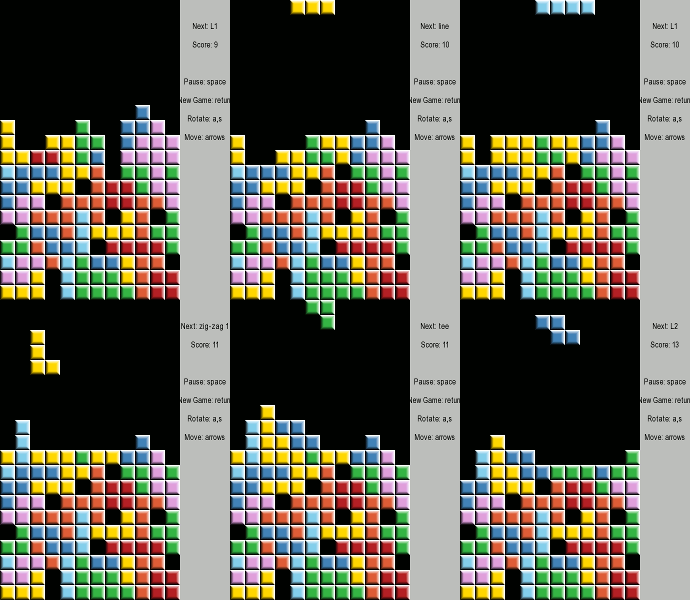
With the onslaught of a new decade here I am more than ever acknowledging that the time for change has come. Things have been fine getting done the old way but it’s time to step it up and change things around. Out with the old, in with the new. It’s time for new hardware, new software; more space in the studio, more light; it’s time to box up old media and other junk I don’t use, on the computer and IRL; time to archive old work and put it away to clear up space for the new work; it’s time to update this website and change how I use it and adapt it to how you use it. There’s no better time than now to evaluate and streamline the good ol’ work processes. Clearing out the clutter of the workspace, both physically in the studio and on the computer will do wonders for my headspace (and yours when you tackle your own cleaning). I’m looking forward to freeing up the RAM in my mind to focus on the new goals instead of dwelling and holding onto the old stuff. I’m looking ahead to completing projects so they can move on out and I can start the new ones. I’m ready to begin the block by block eradication of the clutter of ideas I have that has been piling and piling up like a runaway game of Tetris.

Time to chip away

So with that in the coming months expect to see changes happening around here. I intend to change this site up a bit, the graphical design but also the tactfulness and practicality of it's functioning. But if you think I'm ditching this to focus on a social media account you're high as hell. More than ever before I'm more firmly rooted in the idea that an artist should have a web presence separate of a social media account(s). It's not just a professional stance but a more mental-health conscious one. The internet used to be a big wild world and we used to actually surf it, but this last decade social media conglomerates have developed and tweaked their apps to where the internet funnels thru it and not the other way around. When you get online you head straight to one place, and that one place feeds you internet news and info. Now your incoming information is tagged, curated and optimized specifically to generate ad revenue at the expense of your privacy and attention span. I think when you have your own website, you break away from that social media format. Your "content" (I hate that word in this context) now exists in it's own web space where it can breathe, expand and be explained rather than just be a link to an article somewhere hankering for likes and shares.
That's another thing, likes and shares don't necessarily translate into dollars and sales. And here we are hooked to our phones, checking our latest posts following the numbers like they're gonna cash out and turn into actual skrilla. And look, I'm not knocking any of that. I too love to check the number of likes to my posts, count my followers, see how many people have checked my stories. But what I'm saying is we shouldn't give everything to the conglomerates just cuz we can't not look at our phones for 5 minutes. The thing about surfing the web was it took effort and decision making; you had to think for second about where you wanted to click next. When all your info is funneled into a single timeline and all you have to do is scroll, it removes the very component you're supposed to use when wading through the information super highway, your better judgement. And with such a sedentary task surfing the internet is it's the one thing you could exercise and now that's going away.
Hence the importance of having your own web space; break away from the curated timeline; break away from the imposed limitations and censorship you find in these timeline sites; have a fully dedicated soapbox to espouse your views and opinions, fully formed or not, without having to word it down for a timeline update.

You DON'T need to sign in to continue reading


The funny thing is you most likely have found this post thru a timeline site. And I will continue to post these updates because, hey, that's where all the attention is. Don't get it twisted, social media sites have their uses and advantages. But considering how much they take from us (look how rich they are off of our info) and how they use information against us (the 2016 election etc) it's long passed the time to step back and look at how we use the internet to spread creative ideas, personal stories, and of course (gag) content.
These days it's easier than ever to buy a domain name and throw up a custom website. If your vision is bigger than a profile page and your content is more that just selfies and work-in-progress shots you owe it to yourself to stake a claim of land on the internet super highway. Stop "renting" on social media, making other people rich. Keep all those good ideas for yourself and your site.
And that's what I intend to keep doing. As the months fly off the calendar this year the posts will once again continue to stack up on this site. My site. Where I can say and write and post WHATEVER I want without an easy way to complain or report it. Where you don't need to sign into your account to continue reading.
In the coming weeks I will be rearranging the format of this site to be easier to navigate and find things. I'm gonna clean house and attempt to get rid of what doesn't work and update and enhance what does. This site has been up nearly 9 years and while strides have been made with technology and how we interact with the internet, I've mainly kept the format the same here. So while it's important for me to know how you'll interact with this site, it's also important to me to get the posts up and out the easiest ways possible. It's a learning curve, but I welcome it.
I'm also offering a big welcome to any new fans, followers, and fellow creators! Happy New Year!


1.16.2012

School Schmool

It's been four and a half years since I graduated from the University of Houston with a Bachelor's degree in art. Inside those four and half years I've experienced contingencies that many adults in their mid-twenties face, especially upon leaving college: the death of my first car, the college sweetheart moving away, clocking in at the same menial job that put you through school in the first place. But of all things that I've been through there's still something that's just stuck around, and those are my student loans.
Having to deal with these pesky monthly bills have drastically changed the way I view higher education, and has opened my eyes to how my culture views it as well. When I signed on the dotted line 8 years ago I was completely clueless to how adversely these notes of debt would affect my life. Of course, back then I myself was convinced I would easily snag some grand job with my degree so I could handle them no problem. But that's not the case now, especially in this economy. It's not the economy's fault, though it may be a small factor in a pool of many. My issues with student loans and higher education go deeper than just the college years. No, to understand how I arrived at now, you have to know how I was brought up, and what kind of student I am.
In grade school, although I made it into and graduated from one of Houston's most academically challenging schools (HSPVA), I was not very scholarly. My attitude toward my studies was pretty lax, and I worked hard enough to get my stuff in, barely on time, and at the very least in a form that would earn a passing mark. I excelled at art, mainly 'cause all I wanted to do was draw comics, paint, and make videos while hanging with my friends. I did all that other school work because I was expected to. Don't get me wrong, I love learning. But it seems much of the stuff we worked on in grade school didn't grab me, and I just wanted to get it over with.
Growing up and going to grade school it was instilled in me that I would one day go off to college. All of us would (I'm the oldest in a family with four kids). My parents wanted to give us opportunities they didn't have. Growing up I remember they started a Texas Tomorrow Fund for each of us. Going to college was the next step. And then after college you can get a bangin' job that will pay you way more than if you had a high school diploma alone. My parents never had the opportunity we did, to go to school and live at home long after you turn 18. When they hit 18 they hit the road and moved out. Well, with school being just that, school, I decided to keep my major in Visual Art, mainly because I was pretty good at it and it came easy to me. I went to college not necessarily because I wanted to, but because I was expected to. In hindsight, I figured out that that's not the best attitude to have when you're paying a-couple-a-thousand-a-year-plus to attend, well, any institution that will one day have a major affect on your career.
If I was pretty lax about my academics in grade school, imaginee how I was with the freedom and the partying of college. My first year of college I attended an art school in Oakland, now called CCA. I roomed with a best friend from high school, and we did it BIG. That's about the time I took out my first student loan to cover what the Texas Tomorrow Fund wouldn't cover, being at an out-of-state college and all. At the end of the year, my friend decided he was leaving, going to another school. He sited the price of tuition as a reason. Figuring my tuition would be pretty astronomical for the next three years there, I got startled myself and decided to pack it up and head back to Houston. I figured the Texas Tomorrow Fund would definitely cover my costs. "I mean, a degree is a degree, right? No matter where it comes from?" I thought to myself.
I enrolled at UH, which was a waaay bigger than CCA, and way more academically involved (hello, CCA is an ART school). Long story short, I dropped a few classes here and there after the deadline, wrestled with a Minor in Communications that eventually fell through, and I had to take College Algebra four times before I had a passing grade. I obviously incurred many more expenses than the fund was able to dish out. Hello, to more student loans!
Semester after sludgy semester, I eventually reached a point to where I could count the remaining credits left to achieve, and I numbered my days until graduation. I had no idea what I was gonna do when I got out but by then I was sick of being in school. That's right, I had no idea what I was gonna do when I got out. Maybe I thought I'd be a professional comic creator or something. One thing I was bent on staying away from is teaching. It's all anybody ever thought about career-wise when I told them what kind of degree I was getting. I figured if I wanted to teach in the first place, I would have a degree that specialized in teaching. The first year after school was gravy. The student loans had a grace period and I was keeping busy painting murals for gypsies and working my same-old weekend job. But something was noticeably different. Without any kind of schedule structure, like school, or a daily job (my job was just weekends) I was completely free to do whatever would occupy my time.
That worked out fine for a time, but then the student loan grace period ended. Bills started coming in fast and gradually I starting sinking into the quicksand of personal debt and the need for money. I decided to get a job, I mean, why not? I have a degree, how hard can it be? Well, after creating profiles to numerous job sites, endless revisions to my resume, about a dozen or so different portfolios for my art (graphic design stuff for graphic design jobs), and countless online applications, I'm still in the same spot. Even worse really when you factor in that I quit the weekend job after it started taking it's toll on me. And the bills for loan repayment keep coming, even if you put them on hold for a while. I started to question what I was paying for; was my degree worth the headache of repaying all this money? This art degree, that was essentially getting me nowhere, was it worth it?
Although I had my moments of regret, this post is not a "ShouldaCouldaWoulda" post. Instead this should be a cautionary tale. Honestly, there's a part of me that feels cheated. Here I am growing up coasting through school thinking everything will be gravy once I get that degree. All my life I was waiting for this this to eventually get here and happen, and it does but it doesn't work out the way I thought it would. So, I feel like I've been stuck here, saying to myself "Now what?" I guess the part that stings is realizing that I didn't need a degree in the first place if I was just gonna keep working at my old job, and I definitely didn't need a degree to stay at home, sit on my ass and paint and draw comics. But then I'm paying for it (or being asked to pay) every month. So what am I paying for if my degree can't get me a job so I can pay for the degree? And, kids, that's a VERY important question you need to consider before even thinking about enrolling into college.
These days college is marketed to everybody. Most high schools push the college thing on the kids regardless of what they want to do career-wise. And not everyone can afford college, especially with today's tuition rates and books and other expenses. So the first thing you must consider before you think about application forms is what exactly do you want to do with your life. Not an easy question and still it's kinda overrated these days. But it's straight-forward; What do you want to do with your life? If your answer is a resounding "I don't know" you basically have two choices: one, don't go to school quite yet, or two, apply to a school your friends are attending and "get started on your basics." The second one sounds fun but if you're just floating around it can be pricey. I mean, if your friends move away to a different city, you can always move with them and not attend school but just find a job. I mention these choices because college isn't for everybody. If you want to work on cars, airplanes or other motor vehicles, trade school is usually sufficient (or is it? I haven't done any research into trade schools but they sound like a more specialized alternative to college, especially if they offer job placement in growing fields). Plus, if you dive right into the work force after high school, you might tap into something that grabs you directly from experience. I imagine you might be able to feel out certain fields and see where they are headed next, and from there you can decide if college is necessary for where you would like to be headed.
And so, what if you do know what you would like to study right after after high school and into college? Well, there are things you must be aware of, such as: Are you planning on going for a job with this degree? And if so, how does it relate to the field you are studying? And, what does the current job market look like in this field? Go ahead, take a look around. What is our society in dire need of the moment? My guess would be mechanical and chemical engineering, health care, and technology to name a few. Seems like decent paying jobs with decent chances of landing one would be here. All I'm saying here is, don't be surprised if your Communications degree doesn't lend itself to that computer programming job opening, even though you may have dabbled in a bit of app-building as a hobby. If I would have understood how serious student loans are I probably would have picked a degree field that would have lent itself to faster job placement, such as computer science. Although art is a big part of my life, I do have an affinity for science and the natural world around us.
More questions you would need to ask yourself if you do plan on attending college is what school has the best program for the field you want to study? Where have the graduates ended up and what are they doing now? Would you regard most of them as successful in those field? Growing up, as it was pounded in my head that I needed college, one major detail was left out (I suspect 'cause I'm the first generation in my family to attend): College is where you make connections to future career opportunities. This is why those last few rhetorical questions are crucial, and it can potentially strike down the argument that "A degree is a degree no matter where you attend school." For example, I skipped out on CCA after the first year, not understanding it's proximity to Pixar Animation (or other animation or game) studios and any potential connections that could get me in to that company. Who knows what professors, specialists or scouts I would have met during a four year stint at that college. I could have stayed and took out bigger loans, but then wound up with a gratifying position at a prestigious animation/game studio after college. Sure I'd have much more debt, but I would probably have a cool job doing something I love, being somewhere I feel I'm needed, and making enough to pay down that debt. I mean, it's not guaranteed, but I bet the chances of landing a sweet gig like that are much better with a specific degree from a specific school with a few contacts, than a cold-call portfolio and a painting degree from a university in Texas. If you plan on attending college with the idea of working in a specific field when you graduate, where you attend may play a big part in what kind of job opportunities may be available to you when you graduate. 
All of these questions are very important to ponder if you are considering college as part of your future. If somebody sat me down and talked to me about all these different aspects to consider, my future would be totally different right now. I don't blame anybody, it's just how I was raised and what was afforded to me. And I don't regret my college experience (well, some of it) but I certainly wish I knew about all this to consider, which is why I'm writing about these lessons. Student debt can be avoided all together with proper knowledge and decision making. I didn't even touch on any grants and scholarships that are out there to ease the cost of higher education. Here I am in my hometown, which lacks any kind of visual arts industry, struggling to get a job that more qualified people can't even get. I now view school as I view everything else: it costs money, money that I don't have. Sure, I've thought about graduate school, but to me I only think about how much it costs. I can barely afford to pay my bills now, how the hell am I going to attend grad school? And for what? This bachelor's hasn't done anything for me except put me in debt. If I was told this is how being in debt would be, I would have told Sallie Mae to cram it up her ass. Regarding my student loan debt, I've realized I don't have it nearly as bad as some people. Also, my friend Marcus wrote his take on college and it's role in society.
This doesn't have to be you. College is not for everybody. Don't simply do as you are told, command your own future.

5.17.2011

And Then What?

Watched this documentary the other night, The End of Suburbia, and it confirmed the suspicions that I've already had about the sustainability of our American lifestyle. How this film took seven years to reach my consciousness is beyond me, but I've been thinking about the 'suburban' lifestyle for a while now. I was born and raised in Houston, TX, and here in this sprawling metropolis it is necessary to have a vehicular form of transportation. If you don't you probably won't have a social life. The public transit, Metro, is quite slow at delivering passengers to destinations across town, and that's even if the Metro runs in your area. There's so many places here in urban Texas that don't have public transportation. Not to mention the hours of operation don't extend deep into the night. So having a car here is a MUST.
It's funny when you hear about Houston, and Texas in general, people are so quick to say that the cost of living here is low, and how cheap it is to live here, blah blah blah. What isn't factored in, however, is your transportation, the cost of owning a vehicle that'll get you around town and to work. That's a big chunk being overlooked. We're talking a car note, car insurance, car maintenance (tires, filters,oil changes, brakes), fuel, and associated costs with repairs that are not regular maintenance (like if your transmission goes out). All these together can easily add up to $1000+ any given month. But, that's not the only cost to having a car.
Okay, you have your transportation paid for, now since you are driving a vehicle in public you are subject to the laws that apply. That means having proper registration, and a passing safety and emissions certificate. If your car is not up to par with the emissions standards, then you must shell out more dough for repairs (like an $800 catalytic converter). After you have all your stickers in order, it's time to hit the road. But don't rest easy just yet, there's still more.
Now, as a driver in public you are subject to the laws of the road. And there's plenty. Not only do you have to deal with other crazy drivers out there, but you also must deal with the abominable face of law enforcement - the police. Issues with the law tend to get pretty costly. Getting pulled over for going 2 miles over the limit is enough to get you a ticket, which can cost upwards of $150 or a weekend in defensive driving or both, and if ignored can turn to a one way ticket to jail, in the form of a warrant. I won't even get into the costs of drunk driving, even though it's frowned upon everywhere, it is a way of life here in the H. Shhhhhh! Nobody will talk about or admit to doing it, even though they probably have done it before. Any time you see a knocked over stop sign, a dented light post, or an abandoned front bumper on the corner, remember that somebody was just sober enough to put the car in reverse and flee the scene before anybody would even notice.
Don't get me wrong, I love cars. I embrace a few car cultures, like hot rods and lowriders. I love to cruise around on crisp spring nights in the full moon. It's just that having my own car in this city opened my eyes to all that I have mentioned above. I look around and everybody is in a car. Stacks and stacks of cars (and trucks, lots of trucks in Texas) with only ONE person line the freeways every morning and afternoon to and from work. You hop in your car, go to Mal-Wart, hop back in and go home, hop in your car, go to Timmy Chan's, hop back in and go home. And that's if there's no drive-thru to drive through. I look around, realizing this is the culture I've been raised in. A culture everybody here has been raised in. A culture embedded into the very fabric of America.
And everybody's cool with this?
I guess so. I mean, all ya gotta do now is go to church and wait out the rest of your life until you go to heaven. This is the promise of suburbia. This is what people strive for. And yet, did you all think this would last forever?
Of course you did. This whole lifestyle is brought to us courtesy of cheap, readily available fossil fuels. But now something is happening. The fossil fuels aren't readily available anymore, and hence, aren't cheap anymore. What's gonna happen when this whole lifestyle, this culture, this economic infrastructure becomes too expensive to keep going? There's no easy answer, or a fast way out of this. Too bad we didn't think of this 25 some odd years ago that way we can put into action a long term plan. But, wait a second, we did think of this way back when. Remember when Jimmy Carter put solar panels on the White House? Well, guess who took 'em down. It's funny because all over town people love to complain about gas prices going up. Somehow we've forgotten that owning a car is a luxury, but we've treated it like a necessity. I say let the gas prices go up. Let them go up and up and up. Only then will people actually realize what's happening and do something about it. Unless they just kill each over it, but it's something. It's like what George Carlin said, "What are ya gonna do? Play with your prick for the rest of your lives? You gonna eat at Wendy's and read People magazine until the end of time?"

Here's the trailer to the movie that sparked such a winded post. The whole thing is also available on YouTube, and a torrent for it is HERE.